刷题网站:
python常用数据结构:
点击展开:Python常用数据结构及其基本操作
"""
Python 常用数据结构(对应 C++ STL)及基本操作
================================================
C++              Python
-------------------------
vector           list
stack            list
queue            collections.deque
unordered_map    dict
unordered_set    set
"""
# ==========================================================
# 1. 数组 / 动态数组
# C++: vector
# Python: list
# ==========================================================
arr = [1, 2, 3]        # 创建数组
# 插入元素
arr.append(4)          # 尾部插入 O(1)
# 在指定位置插入
arr.insert(1, 10)      # index=1 插入 10  -> O(n)
# 删除尾部
arr.pop()              # 删除最后一个元素 O(1)
# 删除指定位置
arr.pop(1)             # 删除 index=1
# 修改元素
arr[0] = 100
# 查找元素
print(arr[1])
# 遍历数组
for x in arr:
    print(x)
# ==========================================================
# 2. 栈 (Stack)
# C++: stack
# Python: list
# ==========================================================
stack = []
# 入栈 push
stack.append(1)
stack.append(2)
stack.append(3)
# 查看栈顶
print(stack[-1])
stack.top()
# 出栈 pop
stack.pop()
# 判断是否为空
if not stack:
    print("stack empty")
# ==========================================================
# 3. 队列 (Queue)
# C++: queue
# Python: collections.deque
# ==========================================================
from collections import deque
q = deque()
# 入队
q.append(1)
q.append(2)
q.append(3)
# 出队
q.popleft()
# 查看队首
print(q[0])
# 查看队尾
print(q[-1])
# BFS常用
while q:
    node = q.popleft()
# ==========================================================
# 4. 哈希表 / 字典
# C++: unordered_map
# Python: dict
# ==========================================================
mp = {}
# 插入
mp["a"] = 1
mp["b"] = 2
# 修改
mp["a"] = 100
# 查询
print(mp["a"])
# 判断key存在
if "a" in mp:
    print("exist")
# 删除
del mp["a"]
# 遍历key
for k in mp:
    print(k)
# 遍历key-value
for k, v in mp.items():
    print(k, v)
# ==========================================================
# 5. 集合
# C++: unordered_set
# Python: set
# ==========================================================
s = set()
# 插入
s.add(1)
s.add(2)
s.add(3)
# 删除
s.remove(2)
# 删除(如果不存在不会报错)
s.discard(10)
# 查询
if 1 in s:
    print("exist")
# 遍历
for x in s:
    print(x)
# ==========================================================
# 6. 初始化技巧(刷题常用)
# ==========================================================
# 初始化数组
arr = [0] * 10
# 初始化二维数组
grid = [[0]*5 for _ in range(5)]
# 初始化dict
mp = {"a": 1, "b": 2}
# 初始化set
s = {1,2,3}
# 初始化队列
q = deque([1,2,3])
# ==========================================================
# 7. 常见复杂度总结
# ==========================================================
"""
list
----
append      O(1)
pop()       O(1)
insert      O(n)
访问        O(1)

stack
-----
push        O(1)
pop         O(1)

deque
-----
append      O(1)
popleft     O(1)

dict
----
insert      O(1)
find        O(1)
delete      O(1)

set
---
insert      O(1)
find        O(1)
delete      O(1)
"""
DAY 1
- 1.两数之和 O(n^2):
class Solution(object):
    def twoSum(self, nums, target):
        """
        :type nums: List[int]
        :type target: int
        :rtype: List[int]
        """
        for i,num1 in enumerate(nums):
            if target-num1 in nums[i+1:]:
                j=nums[i+1:].index(target-num1)+1+i
                return [i,j]
哈希表O(n):
class Solution(object):
    def twoSum(self, nums, target):
        """
        :type nums: List[int]
        :type target: int
        :rtype: List[int]
        """
        seen={}
        for i,num1 in enumerate(nums):
            num2=target-num1
            if num2 in seen :
                return [seen[num2],i]
            seen[num1]=i
O(nlogn):
class Solution {
public:
    vector<int> twoSum(vector<int>& nums, int target) {
        map<int, int> s;  // key = num, value = index
        for(int i = 0; i < nums.size(); i++) {
            int complement = target - nums[i];
            if(s.find(complement) != s.end()) {
                return {s[complement], i};
            }
            s[nums[i]] = i;
        }
        return {};
    }
};
O(n):
class Solution {
public:
    vector<int> twoSum(vector<int>& nums, int target) {
        unordered_map<int, int> s;
        for(int i = 0; i < nums.size(); i++) {
            int complement = target - nums[i];
            if(s.find(complement) != s.end()) {
                return {s[complement], i};
            }
            s[nums[i]] = i;
        }
        return {};
    }
};
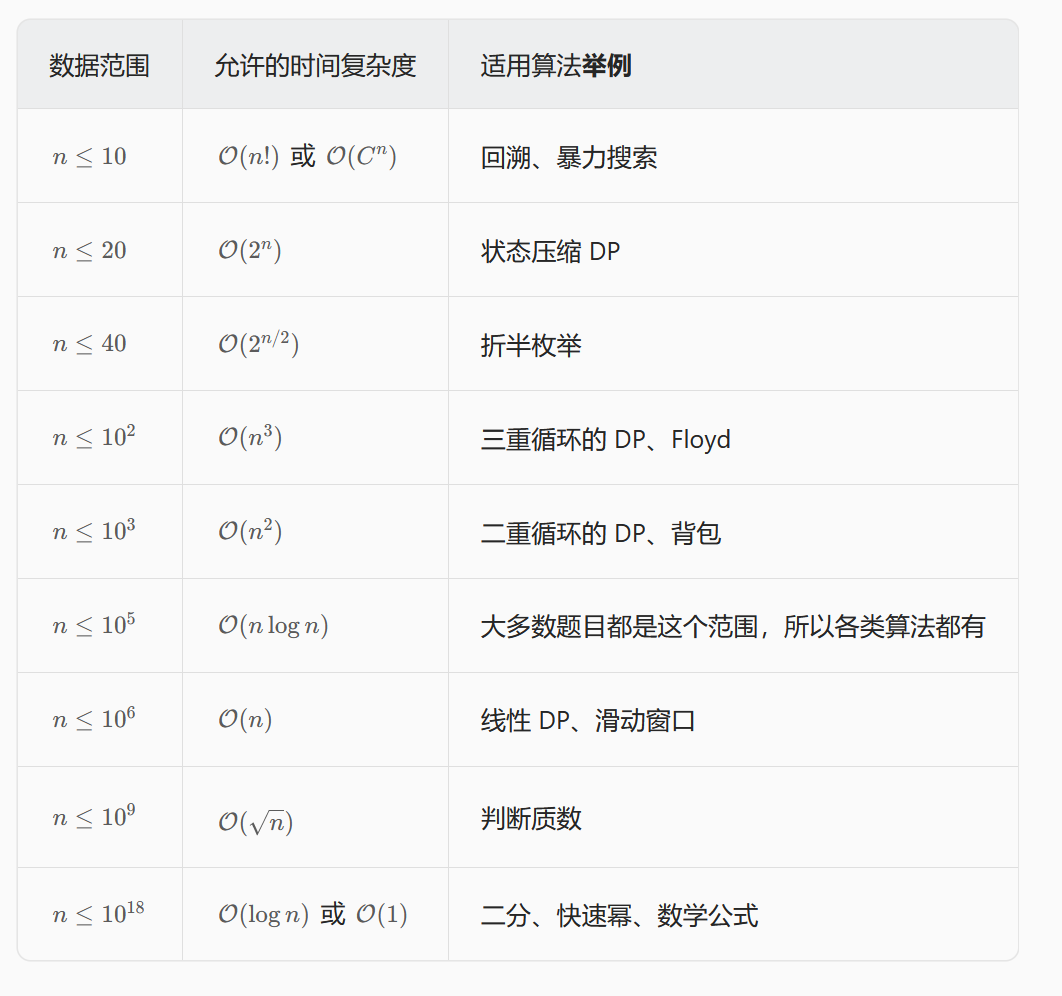
数据规模对应的时间复杂度
- 2.两数相加(基于链表的倒序存储)
思路分别计算两个数的大小,然后相加,最后用链表存储:上述存在的问题在于,直接两数相加会存在溢出风险,可以采用逐位相加的思路:
点击展开
# Definition for singly-linked list.
# class ListNode:
#     def __init__(self, val=0, next=None):
#         self.val = val
#         self.next = next
class Solution:
    def addTwoNumbers(self, l1: Optional[ListNode], l2: Optional[ListNode]) -> Optional[ListNode]:
        length1 = 0
        num1 = 0
        while l1:
            num1 += l1.val * (10 ** length1)
            length1 += 1
            l1 = l1.next
        length2 = 0
        num2 = 0
        while l2:
            num2 += l2.val * (10 ** length2)
            length2 += 1
            l2 = l2.next
        num3 = num1 + num2
        result = ListNode(0)
        cur = result
        if num3 == 0:
            return ListNode(0)
        while num3 >= 1:
            cur.next = ListNode(num3 % 10)
            cur = cur.next
            num3 //= 10
        return result.next
# Definition for singly-linked list.
# class ListNode:
#     def __init__(self, val=0, next=None):
#         self.val = val
#         self.next = next
class Solution:
    def addTwoNumbers(self, l1: Optional[ListNode], l2: Optional[ListNode]) -> Optional[ListNode]:
        dummy = ListNode(0)
        cur = dummy
        carry = 0
        while l1 or l2 or carry:
            v1 = l1.val if l1 else 0
            v2 = l2.val if l2 else 0
            s = v1 + v2 + carry
            cur.next = ListNode(s % 10)
            carry = s // 10
            cur = cur.next
            if l1:
                l1 = l1.next
            if l2:
                l2 = l2.next
        return dummy.next
需要注意:
- 两条链表有长有短,在较短的链表前面补 0,方便相加;
- 每一位计算的同时需要考虑上一位的进位问题,而当前位计算结束后同样需要更新进位值;
- 如果两个链表全部遍历完毕后,进位值为 1,则在新链表最前方添加节点 1;
- 链表的快速建立和初始化:
nums = [1,2,3,4]
dummy = ListNode(0)
cur = dummy
for n in nums:
    cur.next = ListNode(n)
    cur = cur.next
head = dummy.next
- 链表的遍历:
cur = head
while cur:
    print(cur.val)
    cur = cur.next
3.相交链表(哈希/双指针/链表) 双重while循环O(m*n)超时:
可以采用哈希,提高检索效率O(m+n):点击展开
# Definition for singly-linked list. # class ListNode: # def __init__(self, x): # self.val = x # self.next = None class Solution: def getIntersectionNode( self, headA: ListNode, headB: ListNode ) -> Optional[ListNode]: headB_head = headB while headA: while headB: if headA != headB: headB = headB.next else: return headB headA = headA.next headB = headB_head return None也可以采用双指针O(m+n),关键弄懂指针怎么移动的——a+c+b=b+c+a点击展开
class Solution: def getIntersectionNode(self, headA: ListNode, headB: ListNode) -> Optional[ListNode]: setA = set() while headA: setA.add(headA) headA = headA.next while headB: if headB in setA: return headB headB = headB.next return None点击展开
# Definition for singly-linked list. # class ListNode: # def __init__(self, x): # self.val = x # self.next = None class Solution: def getIntersectionNode(self, headA: ListNode, headB: ListNode) -> Optional[ListNode]: PA=headA PB=headB while PA!=PB: if PA: PA=PA.next else: PA=headB if PB: PB=PB.next else: PB=headA return PA4.反转链表(递归/链表) 递归写法:
迭代写法:点击展开
# Definition for singly-linked list. # class ListNode: # def __init__(self, val=0, next=None): # self.val = val # self.next = next class Solution: def digui(self, cur: Optional[ListNode], pre: Optional[ListNode]) -> Optional[ListNode]: # 递归终止:cur为空,返回新的头节点 if not cur: return pre # 保存下一节点 nxt = cur.next # 反转指针 cur.next = pre # 递归处理下一个节点 return self.digui(nxt, cur) def reverseList(self, head: Optional[ListNode]) -> Optional[ListNode]: return self.digui(head, None)点击展开
class Solution: def reverseList(self, head: Optional[ListNode]) -> Optional[ListNode]: prev = None cur = head while cur: nxt = cur.next cur.next = prev prev = cur cur = nxt return prev5.回文链表(双指针/链表) 双指针O(n):
点击展开
# Definition for singly-linked list.
# class ListNode:
#     def __init__(self, val=0, next=None):
#         self.val = val
#         self.next = next
class Solution:
    def isPalindrome(self, head: Optional[ListNode]) -> bool:
        cur = head
        arr = []
        # 将链表存入数组
        while cur:
            arr.append(cur.val)
            cur = cur.next
        left = 0
        right = len(arr) - 1
        # 双指针判断回文
        while left < right:
            if arr[left] != arr[right]:
                return False
            left += 1
            right -= 1
        return True
DAY 2 (滑动窗口专题——定长滑动窗口)
定长滑动窗口模板
for right in range(len(nums)):
    # 1 进入窗口
    add(nums[right])
    # 2 窗口超过k
    if right >= k:
        remove(nums[right-k])
    # 3 窗口大小=k时更新答案
    if right >= k-1:
        update()
- 1456. 定长子串中元音的最大数目
- 643. 子数组最大平均数 I
- 1343. 大小为 K 且平均值大于等于阈值的子数组数目
- 2090. 半径为 k 的子数组平均值
- 2379. 得到 K 个黑块的最少涂色次数
- 2841. 几乎唯一子数组的最大和(结合哈希表)2461. 长度为 K 子数组中的最大和 1423. 可获得的最大点数 3679. 使库存平衡的最少丢弃次数(结合贪心)
点击展开
from collections import defaultdict class Solution(object): def maxSum(self, nums, m, k): """ :type nums: List[int] :type m: int :type k: int :rtype: int 题意: 找到长度为 k 的子数组,使得其中不同元素个数 >= m, 并返回该子数组的最大和。 """ # 记录窗口中每个元素出现的次数 freq = defaultdict(int) # 当前窗口的元素和 window_sum = 0 # 记录满足条件的最大和 max_sum = 0 for i in range(len(nums)): # 1. 右边界进入窗口 freq[nums[i]] += 1 window_sum += nums[i] # 2. 如果窗口超过 k,需要移除左边元素 if i >= k: left_value = nums[i - k] window_sum -= left_value freq[left_value] -= 1 # 如果该元素数量变为0,删除该key # 保证 len(freq) 表示窗口中的 distinct 数量 if freq[left_value] == 0: del freq[left_value] # 3. 当窗口大小达到 k 时,判断是否满足 distinct >= m if i >= k - 1 and len(freq) >= m: max_sum = max(max_sum, window_sum) return max_sum1052. 爱生气的书店老板点击展开
from collections import defaultdict
from typing import List
class Solution:
    def minArrivalsToDiscard(self, arrivals: List[int], w: int, m: int) -> int:
        """
        arrivals : 到达的事件序列
        w        : 滑动窗口大小
        m        : 每个值在窗口内最多允许出现的次数
        目标:
        在任何长度为 w 的窗口中,每个值最多出现 m 次。
        如果超过 m 次,就需要丢弃当前到达的元素。
        返回最少需要丢弃的数量。
        """
        # 记录当前窗口中每个值的出现次数
        freq = defaultdict(int)
        # 标记某个位置是否被丢弃
        discarded = [0] * len(arrivals)
        # 最少丢弃次数
        discard_count = 0
        for i in range(len(arrivals)):
            # 1. 当前元素进入窗口
            value = arrivals[i]
            freq[value] += 1
            # 2. 如果窗口超过 w,需要移除 i-w 位置的元素
            if i >= w:
                left_index = i - w
                # 只有当该元素没有被丢弃时,才需要减少频率
                if discarded[left_index] != 1:
                    freq[arrivals[left_index]] -= 1
            # 3. 如果当前元素出现次数超过 m,需要丢弃
            if freq[value] > m:
                # 回退刚刚加入的频率
                freq[value] -= 1
                # 标记当前位置为丢弃
                discarded[i] = 1
                # 丢弃计数 +1
                discard_count += 1

        return discard_count
DAY 3 (滑动窗口专题——不定长滑动窗口)
不定长滑动窗口模板
for right:
    add()
    while invalid:
        remove()
    update()
- 3. 无重复字符的最长子串
点击展开
from collections import defaultdict class Solution(object): def lengthOfLongestSubstring(self, s): window = defaultdict(int) left = 0 res = 0 for right in range(len(s)): c = s[right] window[c] += 1 while window[c] > 1: d = s[left] window[d] -= 1 left += 1 res = max(res, right - left + 1) return res - 3090. 每个字符最多出现两次的最长子字符串
- 1493. 删掉一个元素以后全为 1 的最长子数组
- 3634. 使数组平衡的最少移除数目
- 1208. 尽可能使字符串相等
- 904. 水果成篮
- 1695. 删除子数组的最大得分
- 2958. 最多 K 个重复元素的最长子数组
- 2024. 考试的最大困扰度
- 1004. 最大连续1的个数 III